

Global Passport Index 2026: Asia’s Extremes — Singapore’s Perfect Score, Hong Kong’s Rebound

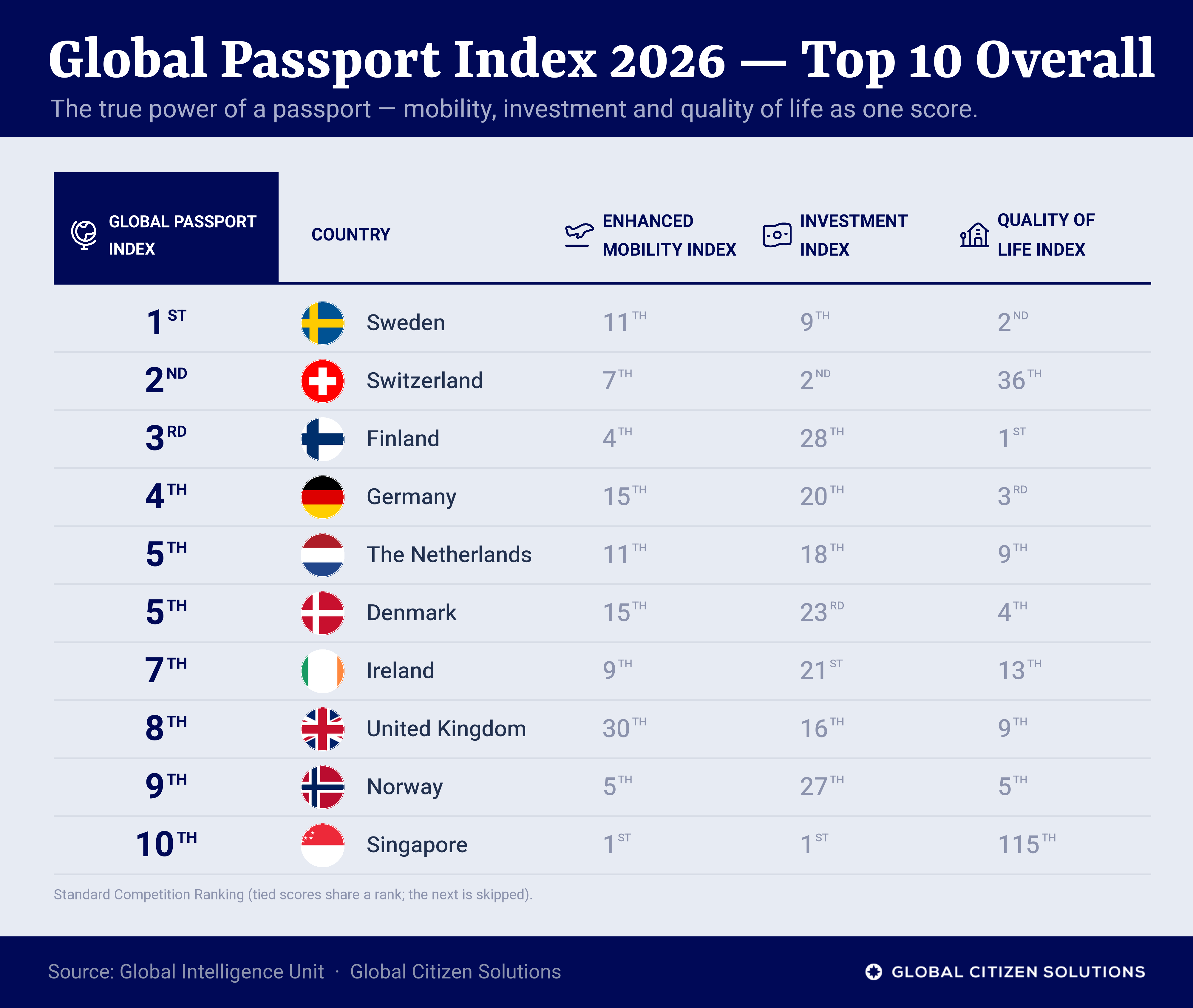
Top 10 passports globally

Singapore tops Asia's passports
Singapore's perfect mobility score, 1st globally on investment, 10th overall, held back by quality of life; Honk Kong strong on investment, rebounds on mobility
In mobility and investment, Singapore’s passport stands tall. No country has paired maximum global access with maximum economic pull as completely or as durably.”
LONDON, UNITED KINGDOM, July 1, 2026 /EINPresswire.com/ -- Sub1: Singapore has held a perfect mobility score of 100 every year since 2021 and ranks 1st globally on investment — yet sits only 10th overall, held back by quality of life — Patricia Casaburi, CEO, Global Citizen Solutions
Sub2: Hong Kong’s mobility rank leapt from 46th to 31st in a single year, reversing a mid-decade slide and lifting it to 31st overall
Sub3: Singapore remains the only Asian passport in the global top ten, which is otherwise composed entirely of European states led by Sweden, Switzerland, and Finland
Global Citizen Solutions (“GCS”), a leading residency and citizenship planning advisory firm, has published the fifth annual edition of the Global Passport Index (GPI), ranking 197 countries on mobility, investment, and quality of life. The 2026 edition highlights Asia’s extremes: Singapore’s unmatched dominance on the dimensions a state can build, and Hong Kong’s sharp single-year rebound on mobility.
The 2026 top ten remains overwhelmingly European: nine of the ten strongest passports in the world belong to European states, led by Sweden (1st, 96.05), Switzerland (2nd), and Finland (3rd), spanning a band of barely three points top to bottom. Singapore (10th, 92.80) is the only non-European entry and the only Asian passport in that tier. Europe is the only region in the index with a positive five-year trajectory, and the Schengen Area’s expansion to 29 states has reinforced a structural mobility premium that no other region approaches. Sweden’s three consecutive years at the top were not built on mobility alone (ranking 14th on mobility), but on consistent strength across all three GPI dimensions: a quality of life position of 2nd globally and an investment climate ranking of 9th. Switzerland and Finland have followed the same upward arc, both moving from outside the top ten in 2021 to lock in second and third place in 2026, confirming that the most durable passport strength in the index reflects genuine excellence across governance and quality of life, not any single pillar.
Asia’s regional scores mask sharp internal variation. Singapore (10th) sits in the global top tier; Afghanistan, Yemen, and Syria anchor the bottom of the 197-country ranking. Singapore leads mobility outright and ranks 1st on investment, ahead of Switzerland and the US. Hong Kong has built its passport strength almost entirely on investment (top six for five editions) while mobility lagged before surging from 46th to 31st in 2026.
“In mobility and investment, Singapore’s passport stands tall. Its travel freedom has been ranked 1st in the world with a perfect score of 100 every year since 2021. On investment it is also 1st. No country has paired maximum global access with maximum economic pull as completely or as durably. That it still ranks only 10th overall comes down to quality of life, where there’s room for improvement.” Patricia Casaburi, CEO, Global Citizen Solutions
“Hong Kong’s passport is a barometer of its identity as a financial gateway. Its investment score has ranked among the world’s top six for half a decade, even as travel freedom wavered and quality of life languished near 120th. The striking development in 2026 is the rebound: mobility leapt from 46th to 31st in a single year. Whatever the political headlines, the passport’s value as a key to global capital, and increasingly to global movement, has proven remarkably resilient.” Dr. Laura Madrid, Global Intelligence Unit Lead Researcher, Global Citizen Solutions
The year’s most striking mobility gain belongs to the UAE, which surged from 26th to 3rd in the mobility sub-ranking in a single year, the most dramatic annual improvement in the 2026 data, demonstrating that active bilateral diplomacy can produce rapid and measurable improvements in passport quality. This movement was a recovery from previous years - in 2021 the UAE was 5th in the mobility dimension and then dropped to 21st and 26th in 2023 and 2024 respectively. Across the Gulf, Saudi Arabia, Qatar, Bahrain, and Oman have all gained ground consistently, collectively showing that deliberate diplomatic passport development, combined with zero-tax investment scores, is producing accelerating and measurable returns in GCS’ measurement of global passport strength.
Beyond Asia, the 2026 index documents a hardening global mobility divide: the gap between the world’s strongest passport (Sweden, 96.05) and weakest (Afghanistan) has widened every year since 2021. Across the Americas, the United States and Canada sit in the global top 15, but the next entry falls more than 30 places below them; in Africa, Mauritius and Seychelles demonstrate that small, well-governed states can reach scores competitive with mid-European countries. In Oceania, New Zealand (25th) and Australia (28th) both lost ground over five years despite strong quality-of-life scores, as post-pandemic bilateral re-impositions eroded mobility gains.
Only 38.5% of the world’s bilateral relationships operate on a symmetric visa basis — the gap between where a passport-holder can travel and where they cannot is, for most of the world’s population, a structural feature of the system rather than an individual circumstance.
The Global Passport Index is annually developed by the firm’s research arm, the Global Intelligence Unit. Now in its fifth edition, the 2026 edition ranks passports across 197 countries on mobility access, investment attractiveness, and quality of life. It measures passport strength across three dimensions: mobility access (the number of countries reachable without a prior visa), investment attractiveness (tax environment, innovation, and economic competitiveness), and quality of life (healthcare, safety, climate, and social infrastructure). The composite score that results from these three pillars captures not just where holders can travel, but the full value of the country that stands behind their document. The gap between the world’s strongest passport (Sweden, 96.05) and weakest (Afghanistan, 23.1) has widened every year since the index launched in 2021.
Global Citizen Solutions is a leading residency and citizenship planning advisory firm, helping high-net-worth clients and their families travel, live and invest across jurisdictions, globally.
Eleanor LEGGE-BOURKE
Global Citizen Solutions
eleanor@globalcitizensolutions.com
Visit us on social media:
LinkedIn
Legal Disclaimer:
EIN Presswire provides this news content "as is" without warranty of any kind. We do not accept any responsibility or liability for the accuracy, content, images, videos, licenses, completeness, legality, or reliability of the information contained in this article. If you have any complaints or copyright issues related to this article, kindly contact the author above.
